

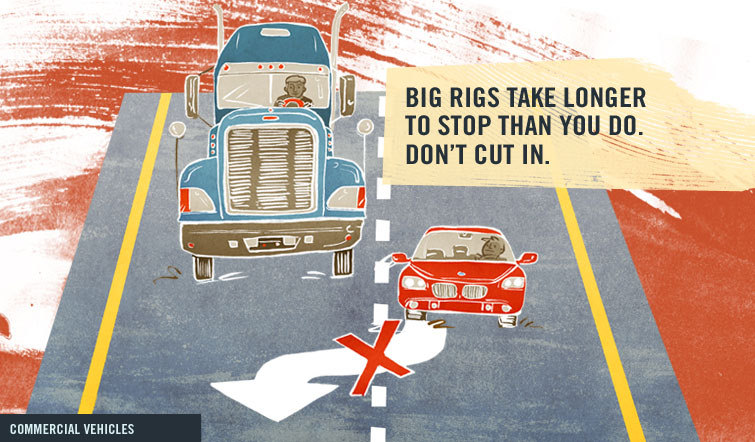
If you can’t see the driver of a big rig, the driver can’t see you either.
 Occupants of a passenger vehicle are more likely to be killed or injured in a collision with a large vehicle because of the differences in weight, stopping distance and rollover potential.
Between 2010 and 2014, 449 people were killed and 9,343 were injured in collisions involving commercial vehicles in Alberta. Of these, 230 people were killed and 3,021 people were injured in collisions with truck tractors.
“It is important for Albertans to understand the tremendous differences between commercial and passenger vehicles. It takes advanced skill to safely operate a large commercial vehicle. They take longer to stop, manoeuvre and accelerate than passenger vehicles do. Drivers of passenger vehicles can do their part by being aware of these challenges every day.”
“It is important to remember that Alberta roadways are a commercial driver’s workspace. As an industry it is our responsibility to ensure that workspace is safe not only for drivers, but for everyone sharing the road. We strive to make safety a mindset, not a concept.”
Commercial Vehicle Facts
- From 2010 to 2014, 2,594 truck tractors were involved in casualty collisions in Alberta.
- There are more than 26,397 National Safety Code carriers in Alberta operating more than 131,128 commercial vehicles.
- Tractor-trailers account for 2.2 per cent of the total vehicles in casualty crashes, but 10.1 per cent of the vehicles in fatal crashes (2014).
- Large vehicles take longer to stop than passenger vehicles. This increased braking time is due to a number of factors, including the size and weight of the vehicle, condition of the vehicle’s brakes and temperature of the brakes.
- Leave at least three metres between your vehicle and the rear of a truck stopped at a light or stop sign, especially on a hill.
- Trucks will usually swing slightly to the left before making a right hand turn; do not assume the driver is turning left.